

The Complete Guide to Gamified Corporate Training
Corporate training has a problem. Despite billions spent annually on Learning and Development, research consistently shows that employees forget up to 70% of training content within 24 hours and 90% within a week. Traditional instructor-led sessions, slide decks, and passive lectures are not delivering the behavior change organizations need.
Gamified corporate training offers a fundamentally different approach. By integrating game mechanics into learning experiences, organizations are seeing measurable improvements in engagement, knowledge retention, and real-world skill application. This guide covers everything you need to know about gamified training: what it is, how it works, what results it delivers, and how to implement it for your organization.
What Is Gamified Corporate Training?
Gamified corporate training is the application of game design elements to professional learning experiences. This includes mechanics like points, challenges, leaderboards, levels, team-based competition, time pressure, rewards, and narrative-driven scenarios.
The goal is not to turn training into a game. The goal is to use the psychology behind why games are engaging and apply those principles to corporate learning. When participants compete, collaborate, and solve problems in a structured environment, they enter a state of focused engagement that accelerates learning.
Gamified training is different from game-based learning, where participants play actual games. In gamified training, the learning objectives remain central. Game mechanics are layered on top to increase motivation, participation, and retention.
Why Traditional Corporate Training Falls Short
Traditional corporate training typically follows a familiar pattern: an instructor presents information, participants take notes, and everyone goes back to work. The problem is not the content itself. The problem is the delivery format.
- Passive learning leads to poor retention. Participants absorb only a fraction of what they hear in lectures.
- One-size-fits-all delivery ignores different learning styles and experience levels.
- No immediate application means skills are forgotten before they can be practiced.
- Low engagement results in distracted participants checking phones and waiting for breaks.
- Difficult to measure behavior change beyond attendance and satisfaction scores.
Gamified training addresses each of these issues by making learning active, personalized, immediately applicable, and measurable.
How Gamified Training Works
A well-designed gamified training program typically includes several core mechanics working together:
Challenge-Based Learning
Participants face specific challenges that require them to apply knowledge, make decisions, and solve problems. Unlike theoretical exercises, challenges create urgency and purpose. Teams must think critically and act decisively.
Competition and Collaboration
Healthy competition between teams drives engagement. Leaderboards, scores, and rankings motivate participants to perform at their best. At the same time, team-based challenges require collaboration, ensuring that individual competition does not override collective learning.
Immediate Feedback
In gamified environments, participants see the results of their decisions immediately. This rapid feedback loop is one of the most powerful learning mechanisms. Instead of waiting weeks for a performance review, learners understand what works and what does not in real time.
Progression and Levels
Challenges increase in difficulty over time, keeping participants in a state of productive challenge. Too easy and they disengage. Too hard and they give up. Well-designed gamified programs maintain this balance throughout the experience.
Narrative and Context
The best gamified training programs wrap challenges in a realistic narrative or scenario. Instead of abstract exercises, participants navigate situations that mirror their actual work environment. This context makes learning immediately relevant and transferable.
The Science Behind Gamified Learning
Gamified training is not just a trend. It is grounded in established principles of behavioral psychology and neuroscience:
Intrinsic motivation: Game mechanics tap into fundamental human drives including autonomy (making choices), mastery (improving skills), and purpose (achieving meaningful goals). These drivers create sustainable engagement that goes beyond external rewards.
Active recall: Challenges force participants to retrieve and apply information rather than passively receive it. Research shows active recall significantly improves long-term retention compared to re-reading or listening.
Emotional engagement: Competition, time pressure, and team dynamics create emotional investment. When learning involves emotion, memory formation is stronger and more durable.
Spaced repetition: Multi-phase gamified programs naturally incorporate spaced repetition as concepts are revisited across different challenges, reinforcing learning over time.
Studies consistently show that gamified approaches improve knowledge retention by 25-40% and increase participant engagement by up to 48% compared to traditional formats.
Types of Gamified Corporate Training
Gamified training can take many forms depending on your objectives, team size, and learning goals:
Gamified Workshops
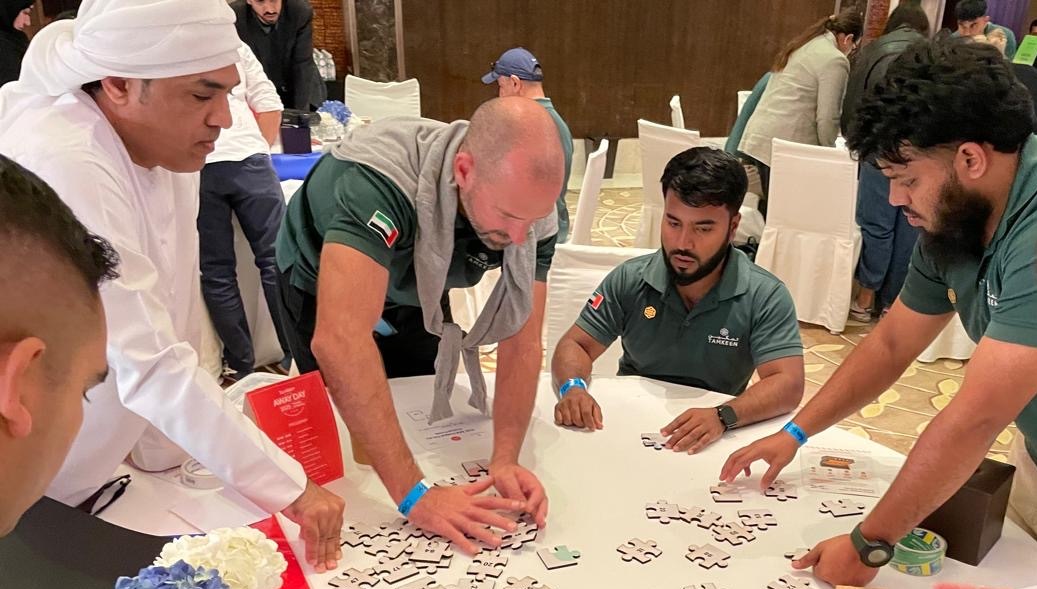
Half-day or full-day facilitated workshops where teams compete in structured challenges. These are ideal for skill building, team alignment, and leadership development. Every workshop is customized to specific learning objectives.
Business Simulations
Immersive scenarios that replicate real workplace dynamics. Participants make strategic decisions, manage resources, and navigate complex situations in a safe-to-fail environment. Simulations are particularly effective for developing leadership, strategic thinking, and cross-functional collaboration.
Gamified Team Building
Team building activities that integrate game mechanics to develop specific capabilities like communication, trust, problem-solving, and collaboration. Unlike entertainment-focused team building, gamified team building is designed to deliver measurable performance outcomes
Gamified Learning Journeys
Multi-phase development programs that combine workshops, simulations, coaching, and on-the-job application with gamified elements throughout. Points, milestones, and progression systems keep participants engaged over weeks or months.
What Results Can You Expect?
Organizations implementing gamified training consistently report improvements across several key metrics:
- Higher engagement: Participants are actively involved rather than passively attending. Completion rates for gamified programs are significantly higher than traditional training.
- Better retention: Knowledge retention improves by 25-40% compared to lecture-based formats, with participants able to recall and apply concepts weeks and months later.
- Faster skill application: Because gamified training is experiential, participants practice skills during the training itself. The gap between learning and application shrinks dramatically.
- Stronger team dynamics: Team-based gamified experiences build trust, communication, and collaboration skills that transfer directly to the workplace.
- Measurable ROI: Gamified training programs can be designed with specific KPIs, making it easier to measure return on investment compared to traditional training.
How to Implement Gamified Training in Your Organization
Implementing gamified training requires thoughtful design. Here is a practical framework:
1. Define clear learning objectives. Start with what you want participants to be able to do after the training, not what you want to teach them. This distinction is critical. Objectives should be behavioral and measurable.
2. Understand your audience. Consider participants' experience levels, learning preferences, team dynamics, and cultural context. Gamified training in the UAE and Saudi Arabia, for example, should account for regional communication styles and organizational culture.
3. Choose the right mechanics. Not every gamified training needs leaderboards and points. Select mechanics that serve your learning objectives. For leadership development, narrative-driven simulations may be more effective. For team building, competitive challenges may work better.
4. Design for active participation. Every participant should be doing something at all times. Minimize observation and maximize engagement. Design challenges that require diverse skills so every team member contributes.
5. Build in reflection. Gamified training without structured debrief is just a game. Include facilitated reflection sessions where participants connect their experience to workplace behaviors and commit to specific actions.
6. Measure and iterate. Track engagement, knowledge retention, skill application, and business impact. Use data to refine and improve future programs.
Gamified Training Across the UAE and Saudi Arabia
The corporate training market in the UAE and Saudi Arabia is evolving rapidly. Organizations across the GCC are moving away from traditional L&D models and embracing experiential and gamified approaches.
Several factors drive this shift: the young, digitally-native workforce expects engaging learning experiences; Vision 2030 and government initiatives emphasize workforce capability development; and multinational organizations operating in the region are adopting global best practices in talent development.
Gamma Zone has delivered over 10,000 hours of experiential and gamified training across the UAE and Saudi Arabia, working with organizations to design learning environments that build real capability. Our approach combines gamified workshops, business simulations, and team building experiences tailored to the specific needs of each organization.