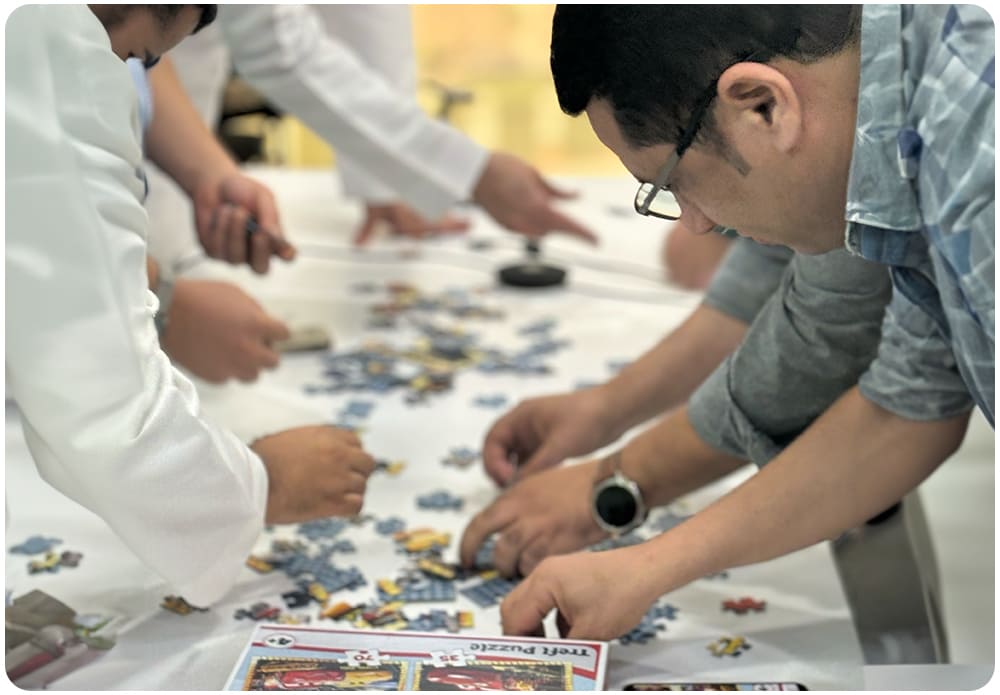



Using Play to Strengthen Team Communication
Communication is the lifeblood of any team, and it is also one of the hardest things to improve deliberately. Telling a team to communicate better rarely works, because the barriers to good communication are usually not a lack of instruction but a lack of the right conditions. People hold back, misread each other, or fail to speak up for reasons that a lecture on communication does nothing to address. A well-designed playful challenge takes a different route. Rather than asking people to practise communicating, it creates conditions where communication becomes necessary, and therefore observable.
This is the key idea, and it is worth stating plainly. The value of a playful communication challenge does not come from participants being told to communicate. It comes from the design of the activity making communication unavoidable. When the mechanics of a challenge require people to talk, listen, and coordinate in order to succeed, the communication is real, and how the team does it becomes visible in a way it rarely is in normal work. This guide explains how a challenge can be designed to make communication necessary, what such an activity reveals about how a team communicates, and how to turn that into lasting improvement.
Communication by Design A well-designed challenge creates conditions where communication becomes necessary, and therefore observable. This is a stronger idea than asking people to practise communicating. When the mechanics of an activity make communication the only route to success, participants are not being told to communicate; the design makes it unavoidable, and how the team communicates becomes visible in the process. |
Designing a Challenge That Makes Communication Necessary
The most reliable way to strengthen communication through a challenge is to build it so that communication cannot be avoided. This is a matter of design, not exhortation. A handful of mechanics reliably force communication to the surface, and combining them produces an activity in which the team must communicate well to succeed at all.
- One person has information another needs, so the two must exchange it to progress
- Instructions cannot be shown, only described, forcing people to put things into words precisely
- Different groups hold different pieces of the solution, so no group can succeed in isolation
- Time pressure makes assumptions costly, exposing where the team fails to check its understanding
- Only one person can communicate between two groups, testing how clearly a single channel carries meaning
With mechanics like these in place, communication is no longer something participants are being asked to practise as an abstract skill. The challenge simply cannot be solved without it. A team that stays quiet, or communicates carelessly, fails at the task, and that failure is immediate and visible. This is what makes a designed challenge so much more effective than instruction: it does not tell the team to communicate, it puts the team in a situation where communicating well is the only way through.
Mechanics That Force Communication Design the activity so that one person holds information another needs, instructions can be described but not shown, different groups hold different pieces of the solution, time pressure makes assumptions costly, or only one person can carry messages between two groups. Any of these makes communication unavoidable. The mechanics do the work that telling people to communicate cannot. |
What a Well-Designed Challenge Reveals
Because a communication challenge makes the team communicate to succeed, it brings the team's real communication patterns to the surface, often more honestly than they appear in normal work, where people are more guarded and self-aware. Observing how a team handles a challenge that depends on communication is one of the clearest windows into how it actually communicates.
Communication patterns become visible
A challenge that depends on communication shows the team how it really communicates: who speaks and who stays quiet, how information flows or fails to flow, whether people listen to each other, how the team handles confusion or disagreement. These patterns, which are often invisible in the flow of normal work, become visible in the concentrated setting of a designed challenge. Seeing them is the first step to improving them, and a well-built challenge surfaces them in a way that feels revealing rather than critical.
Breakdowns surface safely
When communication breaks down during the challenge, it does so safely, without real consequences. A misunderstanding that would cause real problems at work simply causes the team to struggle with the task, which is a low-stakes way to encounter a communication failure. This safe surfacing of breakdowns lets a team notice how its communication fails and learn from it, without the cost that the same failure would carry in real work. A well-designed challenge turns communication failures into learning rather than damage.
The Challenge as a Mirror A challenge that requires communication acts like a mirror, showing the team how it really communicates: who speaks, who stays quiet, how information flows, how confusion is handled. Because it happens in a low-stakes setting, breakdowns surface safely, turning what would be a costly failure at work into a moment of learning the team can act on. |
Turning Insight Into Real Improvement
The value of a communication challenge is captured when the insight and practice from it carry back into the team's real communication. An activity that stays in the room is enjoyable but changes little; one that connects to real work can genuinely improve how a team communicates. Making this connection is what turns a well-designed exercise into lasting improvement.
Reflect on what the challenge revealed
The most important step is reflecting, after the activity, on what it revealed about the team's communication. A facilitated conversation that asks what the team noticed about how it communicated during the challenge, what worked, what broke down, and what that might mean for how the team communicates at work, turns the experience into genuine insight. This reflection is where much of the real value lies, because it connects the safe, revealing setting of the challenge to the team's actual communication challenges.
Draw explicit links to real work
Reflection is most useful when it draws explicit links between the challenge and real work. If the team noticed that quieter members' input was missed, the conversation can explore whether that happens at work too and what to do about it. If the team communicated well under the pressure of the challenge, it can consider how to communicate that well under real pressure. These explicit links are the bridge from insight to improvement, and without them the insight tends to stay in the room.
Practise, do not just observe
Part of the value of a designed challenge is that it lets a team practise good communication, not just observe its own patterns. A team that communicates well to succeed at the challenge has actually practised communicating well, and that practice makes the behaviour more available in real situations. Choosing challenges that require the specific communication a team wants to build, and letting the team practise it in a safe setting, helps make good communication a habit rather than an aspiration.
Using These Activities Well
Communication challenges strengthen communication most reliably when they are designed and used with a little thought rather than dropped in at random. A few principles help ensure they build the communication a team needs.
- Build in mechanics that genuinely require communication, so the activity exercises the skill you want rather than merely entertaining
- Match the challenge to the team, ensuring it suits the group's comfort levels and does not put anyone in an uncomfortable position
- Make space for everyone to participate, since a challenge that only engages the most confident members reveals and builds less than one that draws everyone in
- Always reflect afterward, connecting what the challenge revealed to how the team communicates at work, so the experience produces improvement rather than just enjoyment
Used this way, a well-designed challenge becomes a genuine and engaging route to better team communication. It does what instruction cannot: it makes communication necessary rather than merely encouraged, reveals how the team really communicates, and lets the team practise communicating well in a setting where doing so is the only way to succeed. The activity can be enjoyable, and that helps keep people engaged, but the improvement comes from the design, not from the enjoyment alone.
The Bottom Line
You cannot simply tell a team to communicate better, because the barriers to good communication are about conditions and habit rather than knowledge. A well-designed playful challenge offers a different route: instead of asking people to practise communicating, it creates conditions where communication becomes necessary, and therefore observable. Mechanics such as splitting information between members, allowing description but not demonstration, distributing pieces of the solution across groups, and limiting who can communicate make communication unavoidable, so the team communicates because the challenge requires it.
Such a challenge also reveals how a team really communicates, surfacing its patterns and its breakdowns safely, and it lets the team practise communicating well. The value is captured through reflection that connects what the challenge revealed to the team's real work, drawing explicit links and turning insight into improvement. Designed thoughtfully, with mechanics that genuinely require communication and reflection that ties them back to reality, these activities are a serious and effective tool for building the communication that every team depends on, and one that people can genuinely enjoy along the way.