

Corporate Team Building in UAE & Saudi Arabia: The Complete Guide
Corporate team building has evolved. What was once a one-off annual offsite is now a strategic capability investment that UAE and KSA organizations use to build trust, accelerate decision-making, and prepare teams for the demands of Vision 2030 and Centennial 2071 execution. The best team building programs in 2026 don't just entertain your team. They build measurable team capability that shows up at work the following week.
This guide covers everything you need to know about corporate team building in the UAE and Saudi Arabia. Activity types and selection. Pricing and logistics. Common formats from gamified workshops to escape rooms to leadership retreats. How to measure outcomes. How to choose the right provider. And how to make sure your team building investment translates into real workplace value.
Whether you're an HR Director planning your annual program, a CEO looking to strengthen leadership team cohesion, or an L&D leader building a quarterly team development rhythm, this guide gives you the structure to make informed decisions.
Why This Guide Matters Organizations across the UAE and Saudi Arabia are shifting from annual team building events to quarterly team development practices. The reason: research consistently shows that team capability built through frequent, structured interventions outperforms once-a-year activities by significant margins. The question isn't whether to invest in team building. It's how to invest strategically. |
What Is Corporate Team Building (And What It Isn't)
Corporate team building is a structured set of activities designed to strengthen how a team works together. Effective team building builds trust between team members, sharpens communication patterns, surfaces and resolves hidden conflicts, accelerates collaborative decision-making, and creates shared experiences that strengthen team identity. It's a capability development tool, not just a social event.
What it isn't: a substitute for fixing structural team problems. If your team is misaligned on strategy, if individual performance issues are unaddressed, if compensation systems reward individual heroics over collaboration, no team building activity will solve those problems. Team building amplifies what's already there. Strong teams get stronger. Weak teams need structural intervention first.
How modern team building differs from traditional team building
Element | Traditional Approach | Modern Approach |
| Frequency | Annual or semi-annual offsite | Quarterly or monthly micro-interventions |
| Focus | Entertainment and morale boost | Specific team capability outcomes |
| Format | Social activities, dinners, sports | Challenge-driven, gamified experiences |
| Debrief | Informal chat over coffee | Structured reflection tied to workplace application |
| Measurement | Satisfaction surveys | Team capability outcomes (communication, decision speed, trust) |
| Provider role | Event delivery | Capability development partner |
The Six Categories of Corporate Team Building Activities
Team building activities fall into six broad categories. Each serves different objectives and works better for different team contexts. Understanding the categories helps you choose what will actually move the capabilities you care about.
1. Gamified team challenges
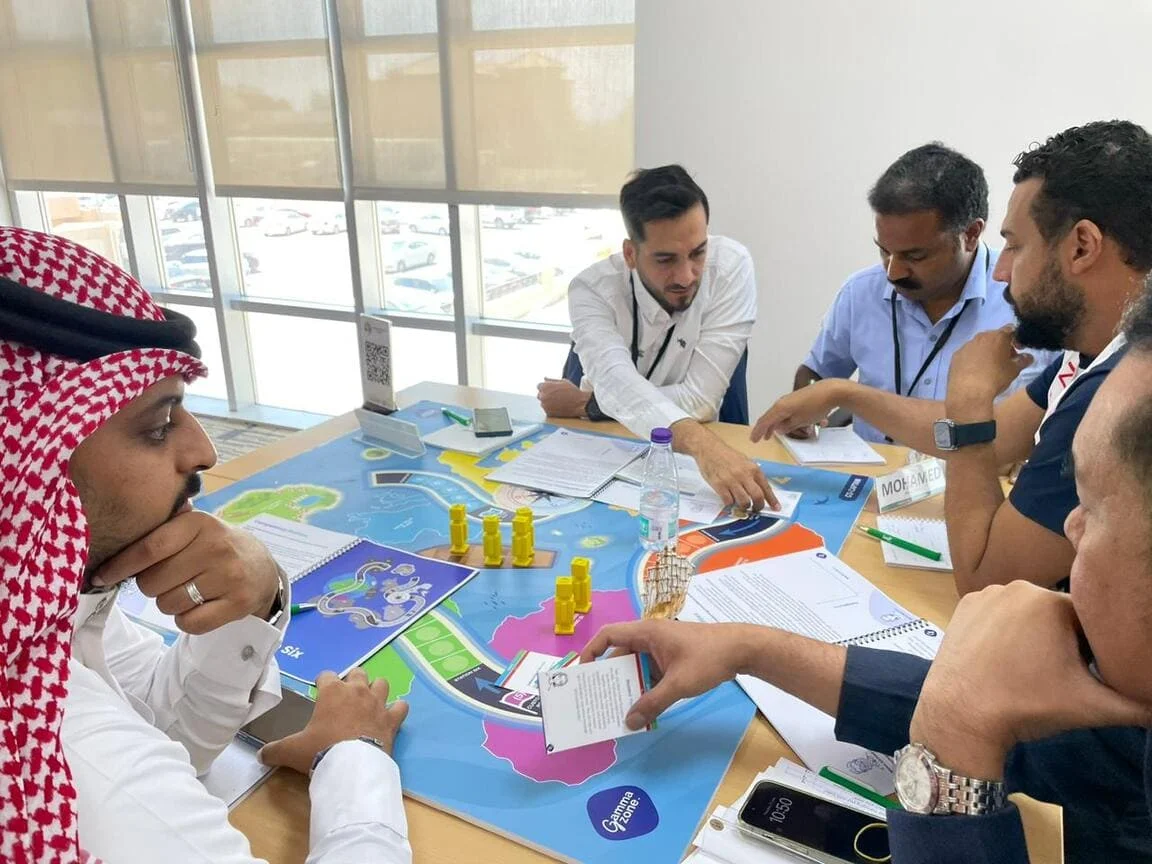
Structured competitive challenges where teams collaborate under time pressure to solve problems, build something, or achieve a goal. Examples include Castle Mania (teams design and defend structures), Pendulum Buster (engineering challenge), Color Rama (multi-station challenge), and Mystery Box (puzzle solving). Best for: building communication patterns, decision-making under pressure, cross-functional collaboration. Typical duration: 90 minutes to 4 hours. Group size: 10 to 200+.
For a deeper look at how to pick the right activity for your team's goals, read our guide to choosing team building activities.
2. Escape rooms
Themed scenarios where teams have 60 to 90 minutes to solve a series of puzzles and escape a fictional situation. Popular themes include Crime Arena (detective work), PatientX (medical crisis), Saving Titanic (disaster response), and Escape the Jungle (survival scenario). Best for: complex problem-solving, leadership under pressure, communication efficiency. Typical duration: 60 to 90 minutes plus debrief. Group size: 10 to 100 in parallel teams.
Learn more about corporate escape rooms in Dubai and how HR leaders use them strategically.
3. Outdoor experiences
Activities held in outdoor settings: desert safaris, hiking, sailing, beach challenges, adventure courses. Best for: stepping outside familiar dynamics, building resilience, creating memorable shared experiences. Important consideration: weather and seasonality are real constraints in the GCC, so most outdoor team building happens between October and April.
4. Indoor experiences
Activities held in offices, hotels, dedicated venues. Examples include workshops, simulations, gamified problem-solving, creative challenges, and innovation labs. Best for: year-round delivery, predictable logistics, focused capability development. The depth of facilitation typically exceeds outdoor formats.
For a detailed comparison, read our analysis of indoor vs outdoor team building.
5. Leadership retreats
Multi-day immersive experiences for senior teams, typically held at premium UAE locations (Ras Al Khaimah, Hatta, Liwa Desert), Saudi Arabia (AlUla, NEOM region), or international destinations chosen for their alignment to development themes. Best for: senior leadership team alignment, strategic thinking development, succession readiness, culture transformation. Duration: 2 to 5 days. Group size: 8 to 40 senior leaders.
Explore when and why to plan a leadership retreat in the GCC.
6. Virtual and hybrid team building
Online or blended formats for distributed teams. Includes virtual escape rooms, online simulations, gamified team challenges over video conferencing, and hybrid formats where some participants are in-person and others join virtually. Best for: distributed teams across the GCC, international cohorts, post-pandemic hybrid teams. Quality matters more here than in physical formats, as design weaknesses are amplified by the medium.
Read our guide to team building for remote and hybrid teams in the UAE.
How to Choose the Right Team Building Activity
Choosing the right activity is the single biggest decision in your team building investment. The same activity can produce strong outcomes for one team and weak outcomes for another. The selection logic should start with the outcome you want, not the activity that sounds fun.
Step 1: Define the team capability you want to develop
Be specific. 'Better communication' is too vague. 'Faster decision-making under uncertainty' is specific. 'Stronger collaboration across functions' is specific. 'Improved trust between team members who have recently joined' is specific. Write down your target capability before you talk to any provider.
Step 2: Identify the team's current state
Where is the team starting from? A newly formed team needs different activities than a long-established team. A team in conflict needs different activities than a high-performing team. A senior leadership team needs different activities than a frontline team. The activity should match the developmental need, not the entertainment preference.
Step 3: Consider logistical constraints
Group size, available time, budget, location preferences, accessibility needs, season, and travel logistics all matter. A 200-person activity has different design requirements than a 12-person one. A 90-minute slot in the middle of a conference has different requirements than a full-day offsite.
Step 4: Match the activity to the capability and context
Use the table below as a starting point for matching capability outcomes to activity formats.
If your goal is... | Strong activity choices |
| Faster decision-making under pressure | Escape rooms, gamified simulations, timed challenges |
| Cross-functional collaboration | Multi-station gamified challenges, complex problem-solving simulations |
| Building trust in a new team | Outdoor adventures, structured icebreakers, leadership retreats |
| Strategic alignment for leadership team | Multi-day leadership retreat, business simulation |
| Resolving team conflict | Facilitated workshops, NOT just activities (intervention first) |
| Celebrating team achievement | Outdoor experiences, social-led formats, recognition events |
| Distributed team connection | Virtual escape rooms, hybrid challenges, periodic in-person retreats |
How Much Does Corporate Team Building Cost in UAE & KSA?
Pricing for corporate team building varies significantly based on multiple factors. Most providers don't publish pricing online because it depends heavily on customization, but understanding the cost drivers helps you budget realistically and evaluate proposals fairly.
The main cost drivers
- Group size - most activities scale per participant, with break points at 20, 50, and 100+
- Duration - half-day, full-day, multi-day pricing differs substantially
- Format complexity - basic activities cost less than custom-designed simulations
- Venue requirements - your office vs. hotel vs. resort vs. international destination
- Customization level - generic activity vs. fully tailored to your organization
- Facilitation depth - basic activity delivery vs. structured workshop with senior facilitators
- Materials and setup - physical materials, technology, branding, and logistics
- Travel and accommodation - for retreats and destination programs
Typical price ranges (UAE & KSA, 2026)
These are typical market ranges from active providers in the region. Actual pricing varies based on the factors above.
Format | Typical Range (per group) | Notes |
| Half-day gamified workshop | USD 4,000 - 12,000 | Group of 20-50, basic to mid-tier facilitation |
| Full-day team building event | USD 8,000 - 25,000 | Group of 20-100, includes lunch and materials |
| Escape room corporate session | USD 3,000 - 10,000 | Group of 10-50 in parallel teams |
| Large-scale event (200+ people) | USD 25,000 - 80,000+ | Complex logistics, multiple stations |
| 2-day leadership retreat (in-country) | USD 30,000 - 100,000+ | Group of 12-25 senior leaders, premium venue |
| International leadership retreat | USD 80,000 - 250,000+ | Includes flights, accommodation, premium facilitation |
| Virtual team building | USD 2,000 - 8,000 | Group of 10-50, technology platform included |
On Pricing Strategy The cheapest team building option rarely produces the best outcomes. The most expensive doesn't always either. The right price for your team is the one that matches the capability outcome you need with the right scope, facilitation depth, and follow-up structure. Optimize for value, not for price. |
Measuring the ROI of Team Building
Most organizations don't measure team building outcomes. They run the event, collect satisfaction scores, and move on. This is one of the reasons HR budgets get cut during downturns. Without outcome measurement, there's no defense against the question 'what did we get from that?' Organizations that measure team building outcomes systematically defend their investments with confidence and build internal credibility for L&D and HR.
Effective team building measurement uses three categories of metrics, captured before and after the activity:
Team capability metrics
Direct measures of the capability you wanted to develop. If you targeted faster decision-making, measure decision throughput before and 30 to 60 days after. If you targeted trust, measure team trust indicators through structured surveys. If you targeted cross-functional collaboration, measure project handoff times or cross-functional initiative success rates.
Behavioral indicators
Observable behaviors that signal capability change. More candid disagreement in meetings. Faster escalation of issues. More cross-functional inquiry. Stronger meeting facilitation. These are leading indicators that show capability is building before the outcome metrics catch up.
Business outcome connection
Where team building supports business outcomes (engagement scores, project delivery rates, customer satisfaction, retention), tracking these creates the credibility you need with CFO and board conversations. Be conservative in attribution. Team building contributes to outcomes but is rarely the sole cause.
For a detailed methodology, read our guide to measuring the ROI of corporate team building.
Common Mistakes to Avoid
Mistake 1: Picking the activity before defining the outcome
'Let's do an escape room this year' is a starting point that produces predictable results. The activity dictates the outcomes, rather than outcomes shaping the activity. Reverse the sequence.
Mistake 2: Treating team building as a once-a-year event
Annual events produce short-lived energy boosts that fade within weeks. Quarterly or monthly micro-interventions produce sustained capability development. The investment doesn't need to be larger annually. It just needs to be distributed.
Mistake 3: Skipping the debrief
The activity is half the value. The debrief is the other half. Activities without structured reflection produce experiences that participants enjoy but don't convert into workplace behavior change. Insist on debrief time as part of every program.
Mistake 4: Excluding managers from the design conversation
Managers control whether the new behaviors get reinforced at work after the team building event. Excluding them from the design means they don't know what to reinforce. Include managers in the briefing before the program and in the follow-up afterward.
Mistake 5: Picking the cheapest provider
Team building providers in the UAE and KSA market range from event coordinators who run basic activities to capability development specialists who design custom interventions. The price difference reflects different value propositions, not different markups. Match provider depth to your outcome ambition.
How to Choose a Team Building Provider
With dozens of team building providers in UAE and KSA, choosing the right one matters. The selection criteria below filter for quality.
- Can they articulate the outcomes their activities are designed to produce, not just the activities themselves?
- Do they ask about your team's current state and goals before proposing activities?
- Do they include structured debrief in their delivery, or just run the activity?
- Can they show real client examples (industries, group sizes, outcome themes)?
- Do they offer customization to your organization's context, or only standard packages?
- Do they engage managers in the design and follow-up process?
- Are their facilitators experienced in your sector or comparable contexts?
- Do they offer follow-up reinforcement, or just one-time delivery?
Providers who pass these filters cost more than basic event coordinators. They produce dramatically better outcomes. The math works out in favor of quality almost every time.
Team Building for Specific Sectors
Team building works differently for different industries. The fundamentals are the same, but the scenarios, examples, and capability priorities differ. Below are common patterns across sectors operating in the UAE and KSA.
- Banking and financial services typically prioritize decision-making under pressure, compliance-conscious collaboration, and client-team alignment. Simulation-based formats work well.
- Healthcare prioritizes crisis response, multi-disciplinary collaboration, and emotional resilience. Medical-themed simulations and structured reflection formats are strong fits.
- Government and public sector teams focus on cross-departmental collaboration, strategic transformation alignment (Vision 2030, Centennial 2071), and large-group cohesion.
- Technology companies value rapid iteration, cross-functional collaboration, and innovation-led thinking. Gamified challenges and hackathon-style formats fit well.
- Retail and hospitality emphasize customer experience alignment, frontline-leadership collaboration, and culture consistency across locations.
- Energy and industrial sectors focus on safety culture reinforcement, operational discipline, and cross-shift team cohesion.
Why Organizations Across UAE & KSA Choose Gamma Zone
Gamma Zone has delivered 10,000+ hours of experiential learning and gamified team building across the UAE and Saudi Arabia, with a 96% client retention rate driven by the measurable outcomes we produce. Our approach combines proven team building activities (escape rooms, gamified challenges, leadership retreats) with the experiential learning methodology that ensures the team capability built during our programs transfers back to the workplace.
What sets our team building apart: every program connects to specific team capability outcomes you define, every session includes structured debrief that translates experience into workplace application, every activity is customizable to your organization's context, and every engagement is designed for measurable impact, not just memorable experiences.
Ready to Strengthen Your Team's Capability? Gamma Zone designs and delivers corporate team building experiences across Dubai, Abu Dhabi, Riyadh, Jeddah, and throughout the GCC. From half-day workshops to multi-day leadership retreats, our programs are designed to build measurable team capability, not just provide memorable events. Explore our team building experiences or contact our team to discuss your team's specific needs. |